
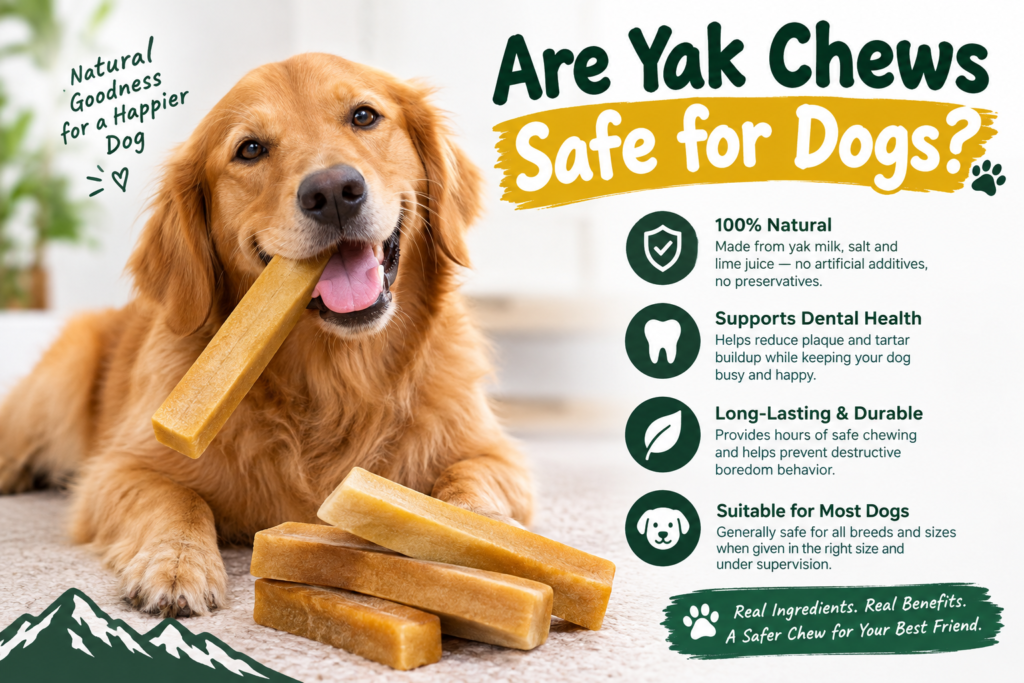
Are Yak Chews Safe for Dogs? What Vets and Government Agencies Say
Are yak chews safe for dogs? The short answer
For many healthy adult dogs, yes. Yak chews are a single-ingredient-style cheese chew with no bone, no rawhide and no artificial fillers. But “safe” depends on your dog’s size, age, teeth and chewing style, and on how you feed the chew.
Three risks matter most:
- Broken teeth. Yak chews are very hard, and hard chews are a known cause of tooth fractures in dogs.
- Choking or blockage. The small end piece that is left near the end of a chew can be swallowed whole.
- Germs on the surface. Like any animal-derived treat, a yak chew should be handled with clean hands, and it should come from a supplier that tests its product.
The FDA’s best-known chew warning covers processed bone treats, not cheese chews, so it does not apply to yak chews directly. But the injuries it describes (broken teeth, choking, blockages) are a useful guide to what can go wrong with any hard chew. The rest of this guide explains each risk with sources from the FDA, the CDC and the National Institutes of Health, then shows how to reduce them.
What are yak chews made of?
Himalayan yak chews, also sold as yak cheese chews, are a hard dried cheese known locally as chhurpi. Families in the Nepal Himalayas have made it for centuries as a way to preserve milk.
YakChewCo describes its traditional recipe as yak milk, cow milk, lime juice and natural salt. The milk is curdled, pressed into shape, then smoke-dried for 28 to 35 days until the moisture content is below 12%. The company’s stated specifications are a minimum of 60% protein and a maximum of 6% fat, with no artificial preservatives. These are the manufacturer’s own figures, so ask any brand you buy from for a batch report that backs them up. You can see how this brand documents its production on its certification page and browse the yak chew range.
That long drying time is what makes the chew last. It is also why the chew is so hard, and hardness is the main safety question.
What the FDA says about hard chews
The U.S. Food and Drug Administration (FDA) regulates pet food and treats. Its Center for Veterinary Medicine has issued two widely quoted warnings about bones, and both help explain how any hard chew can hurt a dog.
- 2010 consumer update, “No Bones About It: Bones Are Unsafe for Your Dog.” FDA veterinarian Carmela Stamper said bones are unsafe no matter their size, and the agency listed ten problems, including broken teeth, mouth and tongue injuries, and fragments lodged in the esophagus or stomach (reprinted by the City of Albuquerque).
- November 21, 2017 update on “bone treats.” The FDA reported about 68 illness reports involving roughly 90 dogs between November 2010 and September 2017, with about 15 dogs reported to have died. Reported problems included digestive tract blockage, choking, cuts in the mouth, vomiting, diarrhea and rectal bleeding. The FDA also received seven reports of product problems such as mold or splintering (NPR summary of the FDA update).
These warnings are about animal bone products. Yak chews are cheese, so they are not what the FDA was describing. Still, the same agency gives advice that applies to every chew you hand your dog: supervise your dog with any chew toy or treat, especially one the dog has not had before, talk with your veterinarian about which chews suit your dog, and call the vet if your dog “just isn’t acting right.”
Risk 1: Can yak chews break a dog’s teeth?
They can, and this is the risk vets mention most for any very hard chew.
A study indexed by the National Library of Medicine (PubMed Central) tested 24 upper fourth premolars, the large chewing teeth, taken from dog cadavers. The teeth fractured at an average force of about 1,281 newtons, and the most common result was a complicated crown fracture, which exposes the inner pulp. The authors concluded that the force needed to break these teeth falls within the chewing ability of the average dog, so hard treats and toys that do not give way may raise the risk. They found no link between fracture force and the dog’s breed, age or weight (Soltero-Rivera and Elliott, Frontiers in Veterinary Science, 2018).
Two cautions about that study. It tested teeth in a lab, not yak chews. And it does not say yak chews break teeth more often than other hard products. What it shows is that a hard, unyielding chew is a real risk for any dog.
A practical rule from Cornell University’s veterinary hospital: a safe chew should be bendable and should dent when pressed with a fingernail (Cornell College of Veterinary Medicine). Many fully dried yak chews will not dent. Press your thumbnail into the chew you actually have, and if you cannot leave a mark, treat it as a hard chew and apply the precautions below.
Signs of a cracked tooth can be subtle. Watch for chewing on one side only, dropping the chew, drooling, pawing at the mouth, or a sudden loss of interest in chewing. Book a dental check if you notice any of them.
Risk 2: Choking and intestinal blockage
Choking and digestive blockage were two of the main problems in the FDA’s reports about hard bone treats, and they can happen with any chew that breaks into pieces or wears down to a swallowable size.
With yak chews the danger point is the end of the chew’s life. As a dog gnaws it down, a small hard nub is left, and some dogs try to gulp it. A nub that fits in the throat can block the airway. One that is swallowed can lodge in the stomach or intestines.
How to lower the risk:
- Choose a chew that is clearly longer than your dog’s muzzle, so it cannot be swallowed whole.
- Stay in the room while your dog chews.
- Take the chew away when it is small enough to fit comfortably in your dog’s mouth, and throw the remainder away.
- Throw away any piece that splinters, develops sharp edges or breaks off in a large chunk.
- Offer fresh water while your dog chews.
If your dog is choking or struggling to breathe, get to a veterinarian immediately. If your dog swallowed a large piece and then vomits, stops eating, seems lethargic or has diarrhea, call your vet the same day; these are among the signs the FDA lists for obstruction.
Risk 3: Germs on dog treats and how to handle them
Animal-derived treats can carry bacteria such as Salmonella, and people can be infected just by handling them. The Centers for Disease Control and Prevention (CDC) and the FDA investigated a 2019 outbreak tied to pig ear dog treats. By the CDC’s July 31, 2019 advisory, at least 127 ill people had been reported, and testing had found many different Salmonella strains in pig ears from many suppliers. The CDC closed the investigation on October 30, 2019 (CDC final update; CDC advisory of July 31, 2019).
That outbreak involved pig ears, not yak chews. It matters here for the handling advice, which the CDC gives for all pet food and treats:
- Wash your hands thoroughly with soap and water after handling pet food or treats. Among ill people in the 2019 outbreak, more than half said they never, rarely or only sometimes washed their hands after handling them.
- Keep treats away from children, and pick up a treat when your pet is finished with it.
- Most people infected with Salmonella develop diarrhea, fever and stomach cramps 12 to 72 hours after exposure.
On the supplier side, a dry, long-aged cheese chew is a different product from a raw meat treat, but the safe choice is the same: buy from a brand that tests each batch for Salmonella and E. coli and will show you the result. YakChewCo states that every production batch is lab tested and that each wholesale shipment includes a Certificate of Analysis.
Which dogs should skip yak chews?
Ask your veterinarian before offering a yak chew if your dog is in any of these groups:
- Puppies still growing adult teeth. Their teeth and jaws are still developing, and a very hard chew is a poor fit.
- Senior dogs and dogs with dental disease. Worn, loose or previously cracked teeth are easier to damage.
- Dogs that gulp. Dogs that bolt food and chews are more likely to swallow the last piece.
- Dogs allergic or sensitive to dairy. Yak chews are made from milk.
- Dogs with a medical condition or special diet. Your vet can tell you whether a high-protein cheese chew fits.
Do not assume that a large dog, or a small one, is automatically in the clear. The fracture study above found no link between breed, age or weight and the force needed to break a tooth. Match the chew’s size to your dog’s mouth, and judge the chew by how hard it is, not by your dog’s size alone.
How to choose and feed a yak chew safely
Use this checklist before you buy and every time you hand one over.
Before you buy
- The label lists the ingredients (milk, lime juice, salt) and the country of origin.
- The brand can show a lab report or Certificate of Analysis for the batch, including Salmonella and E. coli results.
- The size is longer than your dog’s muzzle.
- You pressed a thumbnail into it, and you know whether it dents.
- Your vet has said it suits your dog, especially for puppies, seniors and dogs with dental problems.
Every time you feed one
- You are in the room and watching.
- Fresh water is available.
- You wash your hands after handling the chew, and children do not handle it.
- You take the chew away and throw it out when the end piece is small enough to swallow.
- You throw away any piece that splinters or breaks off in a chunk.
- You store the chew in a dry place away from human food.
For pet stores and brands. If you sell or private-label yak chews, the same questions apply to your supplier: batch testing, clear labeling and a hardness and sizing guide for customers. YakChewCo offers wholesale yak chews and private label production, and you can read about its manufacturing process.
When to call your vet, and how to report a problem
Get to a veterinarian right away if your dog is choking, gagging or struggling to breathe. Call your vet the same day if, after chewing, your dog vomits, has diarrhea, stops eating, seems unusually tired, has blood in the stool, or shows signs of mouth pain such as pawing at the face or refusing to chew.
If you think a yak chew or any other treat made your dog sick, you can also tell the FDA. The agency treats pet treats as pet food for reporting purposes, and anyone can file a report, whether or not they own the affected animal. Reports go through the FDA’s Safety Reporting Portal (how to report a pet food complaint; reporting FAQ).
Helpful details to have ready:
- The exact product name and the original packaging, which the FDA asks you to keep
- How the chew was stored and handled
- Your dog’s symptoms and any diagnosis from your vet
- Whether your dog eats other treats, foods or supplements
Yak chew safety FAQ
Are yak chews safe for puppies?
Ask your vet first. Puppies’ teeth and jaws are still developing, and a very hard chew is a poor match for them. If your vet approves a chew, choose a size they cannot swallow whole and supervise every session.
Are yak chews safer than bones?
They contain no bone, so the splintering and bone-fragment injuries described in the FDA’s bone warnings do not apply directly. Hardness and the swallowable end piece are still risks, so the same supervision rules apply.
Are yak chews easy to digest?
Makers describe them as easily digestible, and the finished chew wears away slowly as a dog gnaws it. A large piece that is swallowed can still block the digestive tract, so remove the chew once it gets small.
Can yak chews cause diarrhea or an upset stomach?
Any new treat can upset a dog’s stomach. Offer a short session at first and watch your dog afterward. Vomiting or diarrhea that does not settle is a reason to call your vet.
How often can my dog have a yak chew?
There is no official limit. Treats are extras on top of a complete diet, and frequency depends on your dog’s size, weight and teeth, so ask your vet what suits your dog.
How do I know if a yak chew is too hard for my dog?
Press your thumbnail into it. If it will not dent, it is a hard chew, and you should weigh the tooth-fracture risk with your vet, especially for seniors, puppies and dogs with dental problems. If your dog starts chewing on one side only or avoids chewing, stop and book a dental check.
Sources and references
- U.S. Food and Drug Administration, How to Report a Pet Food Complaint
- U.S. Food and Drug Administration, Pet Food Safety Reporting Portal Frequently Asked Questions
- U.S. Food and Drug Administration, “No Bones About It: Bones Are Unsafe for Your Dog” (Consumer Update, 2010), reprinted by the City of Albuquerque
- U.S. Food and Drug Administration, bone treat warning (Consumer Update, November 21, 2017), as summarized by NPR
- Centers for Disease Control and Prevention, Investigation Update on Salmonella from Dog Treats (October 30, 2019)
- Centers for Disease Control and Prevention, Salmonella Outbreaks Linked to Pig Ear Dog Treats (July 31, 2019)
- National Library of Medicine (PubMed Central), Soltero-Rivera M, Elliott MI, Fracture Limits of Maxillary Fourth Premolar Teeth in Domestic Dogs Under Applied Forces, Frontiers in Veterinary Science, 2018
- Cornell University College of Veterinary Medicine, FDA “bone treat” warning: Cornell veterinarian explains how you can protect your dog
- YakChewCo, product and manufacturing information (company-stated specifications)
This article is general information, not veterinary advice. Talk to your veterinarian about the right chews for your dog.